


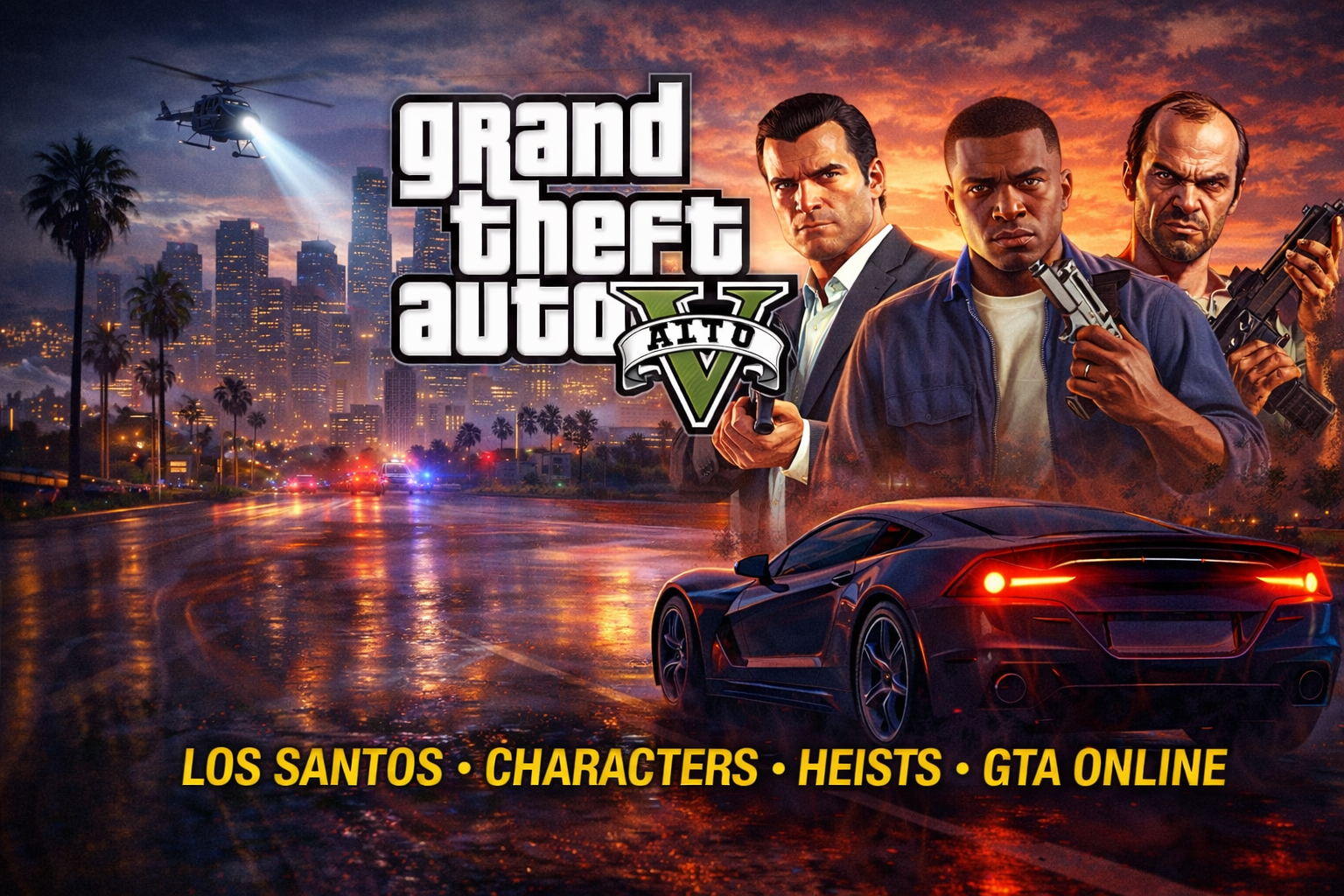
Grand Theft Auto V (GTA V) is Rockstar Games’ 2013 open-world action-adventure blockbuster set in Los Santos and the surrounding Blaine County—a sun-soaked metropolis and its rural fringe, packed with missions, heists, vehicles, reactive NPCs, and a wanted system that turns chaos into the game’s core loop. Rockstar originally announced a worldwide launch for PlayStation 3 and Xbox 360 on 17 September 2013.
What keeps GTA V relevant more than a decade later isn’t just the story mode—it’s the “platform effect”: GTA Online’s ongoing updates, plus new versions across console generations and PC.
GTA V at a glance
| Quick fact | Snapshot |
|---|---|
| Developer / publisher | Rockstar Games (Rockstar North led development) |
| Original release date | 17 September 2013 (PS3, Xbox 360) |
| Latest major console release | PS5 / Xbox Series X|S versions launched 15 March 2022 |
| Setting | Los Santos + Blaine County |
| Signature mechanics | Open world + sandbox gameplay + character switching + heists + wanted level |
| Sales milestone (reported) | GTA V sold-in over 215 million units as of Take-Two’s FY2025 year-end commentary |
| UK age rating (example listing) | PEGI 18 (UK Games Rating Authority listing) |
Terminology note: “Sold-in” is a publisher metric (units shipped into retail + digital units sold) and is the wording used in Take-Two’s reporting.
What is GTA V, exactly?
Think of GTA V as three games layered together:
- Open world: a living map designed for free exploration.
- Sandbox gameplay: you choose how to move, play, and respond—often with multiple valid approaches.
- Mission structure: Rockstar’s curated story progression, with rewards, unlocks, and set pieces.
In Rockstar’s own release-date announcement, the studio framed Los Santos as a “sprawling sun-soaked metropolis” and highlighted three different criminals at the heart of the story—Franklin, Michael, and Trevor—plus a “series of daring and dangerous heists.”
The world: Los Santos + Blaine County
GTA V’s map works because it’s built like a real place: dense urban districts, iconic landmarks, highways that actually matter, and rural roads that change how you travel and escape.
Key regions (high-intent overview)
| Region | What it represents | Why it matters to gameplay |
|---|---|---|
| Los Santos | A Los Angeles-style urban simulation | Mission density, traffic, police escalation, “city stories” |
| Blaine County | Rural sprawl around the city | Off-road routes, hideouts, open spaces for chases and encounters |
| Vinewood | A Hollywood-style parody district | Cultural satire + landmark-driven exploration |
| Mount Chiliad | The map’s “big horizon” | Exploration, secrets culture, long-form free roam |
This city-to-country contrast is a huge reason GTA V stays replayable: the same systems (wanted level, traffic, NPC behaviour) feel different depending on where you are.
The protagonists: Michael, Franklin, and Trevor
GTA V’s biggest narrative gameplay innovation is the protagonist trio and character switching, letting you jump between three perspectives to create pace, contrast, and mission variety.
Rockstar’s 2013 announcement explicitly called out that the game “blends storytelling and gameplay… as players repeatedly jump in and out of the lives of the game’s three lead characters.”
Trio cheat sheet
| Character | Core identity | Typical fantasy |
|---|---|---|
| Michael De Santa | Retired pro criminal with a messy “normal life” | Crime drama, planning, consequence |
| Franklin Clinton | Ambitious street hustler climbing fast | Progression, skill growth, “getting out” |
| Trevor Philips | Unpredictable chaos engine | Disruption, shock, explosive momentum |
Why it works (semantic angle): switching turns the narrative into a system—Rockstar structures missions around perspective changes and uses the trio to expand tone (satire, tension, comedy) without losing cohesion.
Missions + heists: Rockstar’s progression engine
If the open world is freedom, missions are direction. GTA V uses missions to:
- guide you through new districts,
- reward you with money and unlocks,
- and escalate stakes through set pieces.
The heist loop (simple model)
- Heist planning (choose approach, roles, prep)
- Prep work (acquire tools, information, access)
- Execution (multi-stage mission, escalating pressure)
- Aftermath (heat, consequences, narrative shift)
Rockstar spotlighted heists as the crew’s make-or-break path in its release announcement.
Wanted level + Police AI: GTA’s signature pressure system
GTA V’s “crime fantasy” is powered by one thing: consequence that scales.
How the wanted system feels in practice
| Wanted level (concept) | What changes | What players learn |
|---|---|---|
| Low | Local pursuit | Driving lines + quick exits matter |
| Medium | Wider response | Hiding, route planning, losing line-of-sight |
| High | Heavy pursuit | Survival, distance, terrain choice |
This system is why vehicles, map knowledge, and improvisation matter as much as shooting mechanics—escaping is often the real objective.
Vehicles + driving mechanics: the game’s heartbeat
GTA V is as much a driving game as anything else. Vehicle variety turns travel into gameplay and makes the map feel larger.
Vehicle categories you’ll see everywhere
| Category | Role in the sandbox |
|---|---|
| Sports cars | Speed, prestige, street racing fantasy |
| Motorcycles | Agility, weaving traffic, fast escapes |
| Aircraft | Route breaking, spectacle, vertical exploration |
| Boats | Coastal travel, water-based missions and roaming |
Combat, health, armour, and stealth (high-level)
GTA V supports multiple engagement styles:
- Shooting mechanics + cover system for direct fights
- Stealth mechanics for quieter approaches
- Health system + armour to manage survival and risk
(If you’re publishing for broad audiences, keep this section descriptive—focus on systems, not “how to”.)
Economy systems: money, property, and the stock market
GTA V’s economy adds long-term motivation:
- earn and spend loops (weapons, vehicles, upgrades),
- property ownership (income-generating assets),
- and the stock market mechanic for players who like optimisation.
This is also where GTA V’s satire shines—consumer culture, media parody, and “get rich” fantasies are part of the worldbuilding, not just jokes.
Side missions, strangers, random events (how the open world stays “alive”)
Beyond the main story, GTA V uses:
- Side missions (optional progress),
- Strangers and Freaks (oddball side narratives),
- Random events (emergent encounters),
- Collectibles + Easter eggs (community-driven discovery)
These systems make it easy for players to “create their own episode” just by wandering—one of the simplest reasons the game remains a streaming staple.
GTA Online: why GTA V became a long-running platform
Even if you only play story mode, GTA Online is a big part of GTA V’s longevity.
In Take-Two’s investor deck, Rockstar describes GTA Online as:
- an ever-changing world driven by regular free updates,
- free with every copy of GTA V,
- with a standalone version launched 15 March 2022, and a GTA+ membership programme launched in March 2022.
Rockstar’s own Newswire announcement confirms the PS5 / Xbox Series X|S versions of GTA V and GTA Online arrived on 15 March 2022.
Roleplay servers and FiveM (quick context)
Take-Two has also noted ongoing development of Rockstar’s FiveM creator platform as part of continued engagement with the series.
Versions and platforms timeline (so readers stop Googling mid-article)
| Version | Platform(s) | Date / note |
|---|---|---|
| Original launch announced | PS3 / Xbox 360 | Worldwide launch date set for 17 Sep 2013 |
| Later releases | PS4 / Xbox One / PC | Released later on additional platforms (PS4/XB1 in 2014; PC in 2015) |
| Latest console generation | PS5 / Xbox Series X|S | Arrived 15 Mar 2022 (with GTA Online) |
GTA V by the numbers (publisher-sourced highlights)
| Metric | What’s reported | Source |
|---|---|---|
| GTA V units sold-in | Over 215 million | Take-Two FY2025 commentary |
| GTA franchise scale | Franchise sold-in nearly 460 million | Take-Two investor deck |
| GTA Online standalone + GTA+ | Standalone launched 15 Mar 2022; GTA+ launched March 2022 | Take-Two investor deck |
| US sales claim (retail tracking window) | “Best-selling title of the past 10 years in the U.S.” (Apr 2015–Apr 2025) | Take-Two investor deck (Circana cited) |
Cultural impact (and why GTA V is always debated)
GTA V is built on cultural satire and pop culture parody—fake brands, media jokes, tech spoofs, and a constant commentary on fame, consumerism, and crime drama. Rockstar even framed Los Santos as a place of “self-help gurus, starlets and fading celebrities” in its 2013 release-date announcement.
UK rating note
In the UK, the Games Rating Authority issues PEGI age ratings; an example listing for GTA V shows PEGI 18.
GTA V is an open-world crime sandbox set in Los Santos and Blaine County, built around a story mode featuring three playable protagonists and a mission structure that includes major heists.
The story follows Franklin, Michael, and Trevor, and Rockstar designed the game so players can switch between the trio as the narrative unfolds.
Rockstar announced a worldwide launch for PS3 and Xbox 360 on 17 September 2013.
Take-Two reported GTA V has sold-in over 215 million units (as of its FY2025 year-end commentary).
Take-Two’s investor materials describe GTA Online as free with every copy of GTA V, supported by regular free updates, with a standalone version launched on 15 March 2022.