


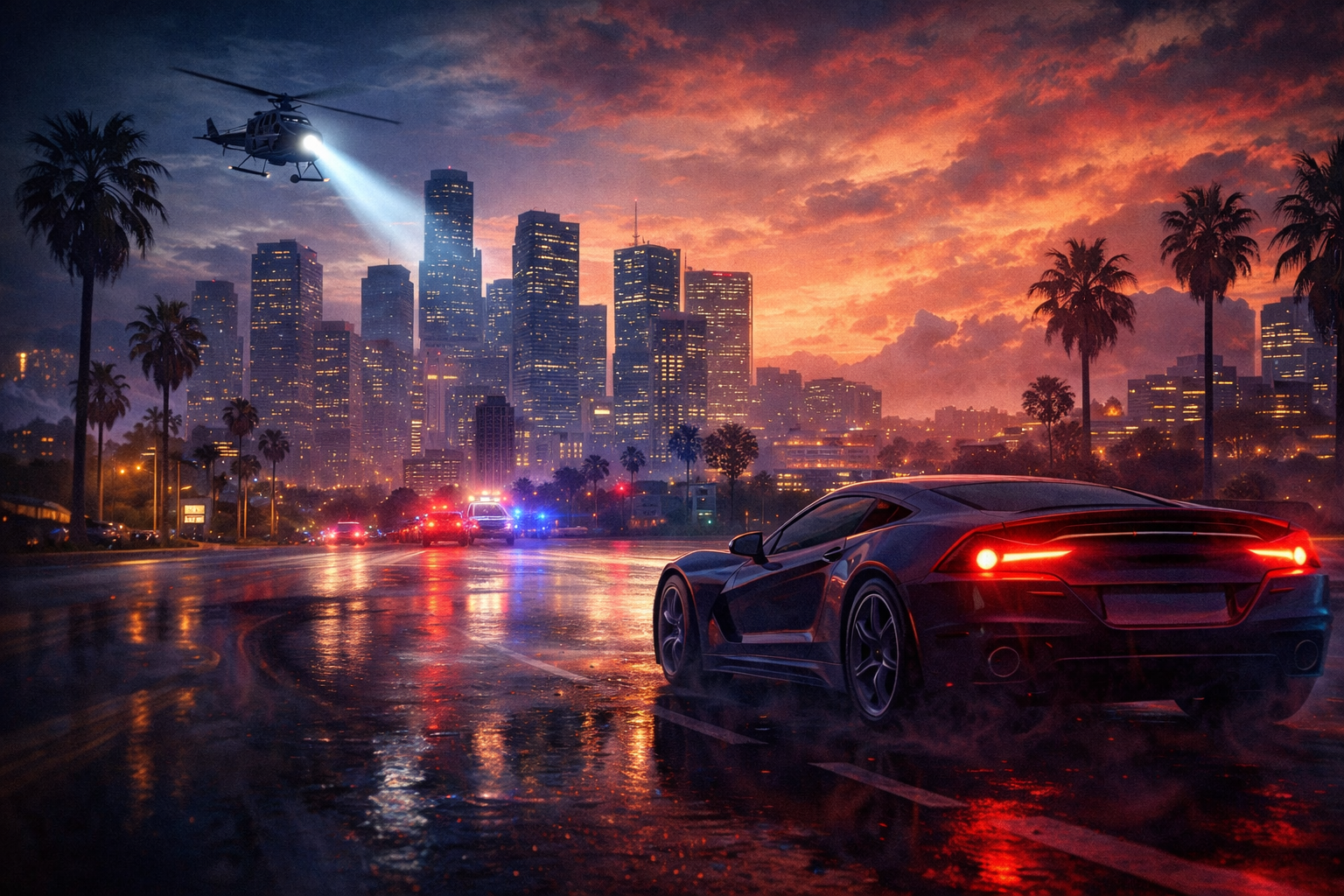
Grand Theft Auto (GTA) is Rockstar’s open-world action-adventure franchise built around crime-driven sandbox play: you explore a living city, take on missions, steal vehicles, manage a wanted level, and interact with NPCs who react to your actions. The series debuted in 1997 and has since evolved into one of entertainment’s biggest long-running game franchises.
GTA at a glance
| Quick fact | Snapshot |
|---|---|
| Franchise | Grand Theft Auto (GTA) |
| Developer/publisher | Rockstar Games (under Take-Two Interactive) |
| Core identity | Open world + sandbox gameplay + mission structure + wanted system |
| Franchise scale | Sold-in nearly 460 million units (Take-Two investor materials) |
| Biggest title | GTA V: over 220 million units sold-in |
| Next mainline release | GTA VI: 19 November 2026 |
Sold-in vs sold-through: “Sold-in” is the publisher metric (units shipped into retail + digital units sold), and it’s the phrasing used in Take-Two’s GTA franchise figures.
Why GTA became the blueprint for open-world games
Take-Two describes GTA as having pioneered the open-world genre, and that’s a fair summary of what players feel: GTA cities aren’t just backdrops—they’re systems you can push, break, and exploit.
At its best, GTA delivers three things at once:
- Open World (exploration)
A dense map invites free roaming—streets, alleys, districts, highways—so “getting there” is part of the experience. - Sandbox Gameplay (player freedom)
There are multiple ways to approach situations—stealth, chaos, fast talk, brute force, escape routes—so the same mission can feel different across playthroughs. - Missions (structure + rewards)
Missions give pace and purpose: money, unlocks, new areas, new tools, new characters. They also anchor the story.
The GTA “system stack” (the mechanics that create chaos)
Here’s the gameplay backbone you’ll see referenced across the series:
| System | What it does | Why it matters |
|---|---|---|
| Wanted Level | Escalates police response as you commit crimes | Turns small mistakes into citywide chases |
| Police AI | Pursues, tracks, blocks, surrounds | Creates the signature GTA “heat” loop |
| Vehicles + car theft | Driving is constant; theft is core | Movement + crime combine into instant gameplay |
| NPCs (pedestrians, gangs, police) | Populates the world and reacts | Makes the city feel occupied, not empty |
| Map + minimap + HUD | Navigation + information | Supports high-speed decision-making |
| Side missions + activities | Optional content loops | Adds longevity beyond the story |
This is why GTA still feels modern: it’s not only story—it’s interlocking simulation loops.
GTA’s cities and what they represent
GTA’s settings are more than “maps”; they’re satirical mirrors of real-world places, with distinct tone and culture:
- Liberty City: a New York–style pressure cooker (grit, ambition, density).
- Vice City: neon, nightlife, excess (iconic 80s/modern Miami energy).
- San Andreas / Los Santos: California vibes—sprawl, celebrity culture, gangs, wealth contrast.
These places give Rockstar a canvas for satire, pop culture references, and urban simulation—a huge part of GTA’s cultural impact.
Story Mode vs GTA Online
Story Mode
Story Mode is the narrative campaign: structured missions, cutscenes, character arcs, and handcrafted set-pieces. It’s where GTA’s dialogue, voice acting, and cinematic storytelling do the heavy lifting.
GTA Online (live-service evolution)
GTA Online is the long-running multiplayer ecosystem attached to GTA V, and it’s one reason GTA V remains unusually durable.
A useful way to understand GTA Online is through Take-Two’s business language: recurrent consumer spending is revenue generated from ongoing engagement (virtual currency, add-on content, in-game purchases, and in-game advertising).
In Take-Two’s fiscal Q2 2026 results, the company reported total net bookings of 1.96 billion US dollars, and said recurrent consumer spending made up 73% of that figure. Converting using the 2026 average exchange rate of £1 = 1.352 US dollars, that’s roughly £1.45bn in net bookings for the quarter.
Modding, roleplay servers, and FiveM (why it matters now)
GTA’s PC ecosystem is huge partly because of modding—from graphics mods to full roleplay communities.
Rockstar has also moved closer to the roleplay scene: Rockstar’s Newswire confirmed that Cfx.re (the team behind FiveM and RedM) became “officially a part of Rockstar Games,” alongside a stated intent to support the roleplay creator community.
This is significant for semantic SEO coverage because it connects:
- modding → roleplay servers → FiveM → creator community → Rockstar policy/support,
which is exactly the kind of entity relationship Google expects in a comprehensive GTA explainer.
GTA by the numbers (credible, publisher-sourced milestones)
| Metric | Figure | Source |
|---|---|---|
| GTA franchise units sold-in | Nearly 460 million | Take-Two investor materials |
| GTA V units sold-in | Over 220 million | Take-Two investor materials |
| Trailer 1 views (24 hours) | 93m+ | Take-Two investor materials |
| Trailer 2 views (24 hours) | 475m+ | Take-Two investor materials |
GTA VI: what’s confirmed
If you only want the confirmed headline:
Grand Theft Auto VI is set to launch on Thursday, 19 November 2026.
Take-Two’s investor materials also tie major demand signals to the launch cycle (e.g., the trailer view milestones above).
Grand Theft Auto is an open-world action-adventure franchise built around crime-themed sandbox gameplay, where players explore large cities, complete missions, and interact with reactive AI systems. The series began in 1997.
Take-Two reports the GTA franchise has sold-in nearly 460 million units, and GTA V alone has sold-in over 220 million units.
Rockstar has announced GTA VI will launch on 19 November 2026.
GTA Online is the multiplayer, live-service component connected to GTA V, built around ongoing updates, progression, economy systems, and player-driven activities.
FiveM is a major roleplay/creator platform for GTA V on PC. Rockstar has confirmed that the Cfx.re team behind FiveM and RedM is now part of Rockstar Games, signalling stronger official support for roleplay creators.