


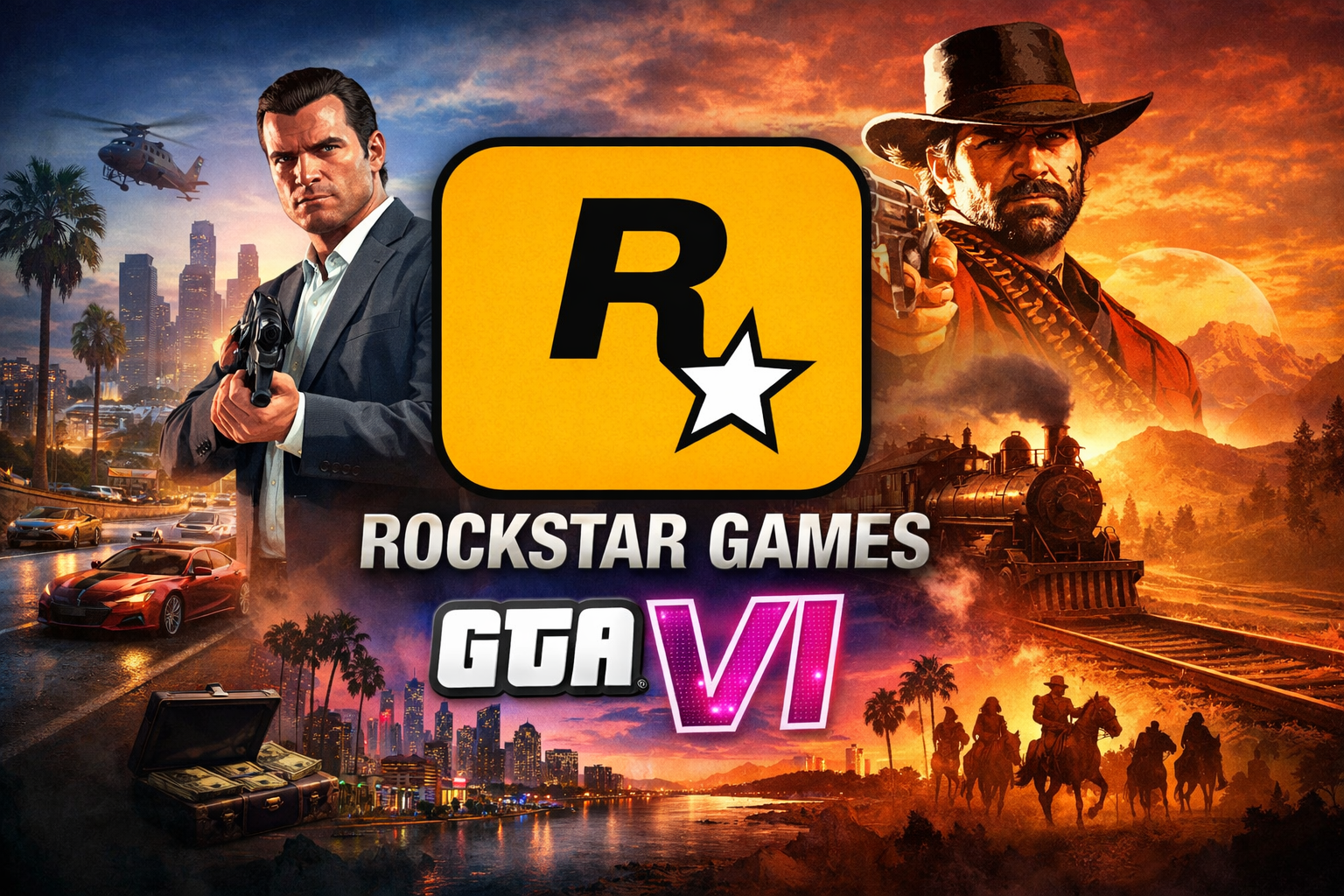
Rockstar Games is a video game publishing label and developer network best known for building cinematic open worlds—most famously Grand Theft Auto and Red Dead Redemption. The label was founded in 1998 and is a wholly owned subsidiary of Take-Two Interactive Software, Inc.
Below is a practical, data-led guide to what Rockstar is, how its studio model works, why its games feel so “alive”, and what’s officially confirmed about GTA VI.
Rockstar Games at a glance
| Quick fact | What to know |
|---|---|
| Founded | 1998 |
| Ownership | Wholly owned by Take-Two Interactive |
| Signature style | Open-world design + sandbox gameplay + cinematic narrative (systems-driven worlds with strong storytelling) |
| Biggest franchises (by reported units “sold-in”) | GTA franchise (~460m), GTA V (220m+), Red Dead series (106m+), RDR2 (79m+) |
| GTA VI release date | Thursday, 19 November 2026 |
Note on “sold-in”: Publishers often report sold-in (units shipped into retail + digital units sold) rather than sold-through (consumer purchases measured at checkout). Rockstar/Take-Two uses sold-in in its investor materials.
What makes Rockstar Games different
Plenty of studios build open worlds. Rockstar’s distinguishing edge is how it stacks systems and storytelling so the world feels reactive:
- Open-world design: large maps built to encourage exploration (not just mission-to-mission travel).
- Sandbox gameplay: multiple valid ways to approach situations (player agency over strict scripting).
- Narrative design: cinematic missions, cutscenes, and character arcs—without sacrificing free-roam.
- World simulation: wanted systems, law enforcement AI, NPC routines, weather/day-night cycles, and economy loops that make the world feel “occupied”.
That combination is why Rockstar games tend to dominate not just sales—but conversation, streaming culture, and long-tail engagement.
Rockstar’s studio model
Rockstar operates as a coordinated label across a network of internal studios—Take-Two describes Rockstar as having 10 internal studios in its investor materials.
Key studios and common roles (high-level)
| Studio | Common association | How it supports the “Rockstar” output |
|---|---|---|
| Rockstar North (Scotland) | Core Grand Theft Auto development | Large-scale open-world systems + mission design |
| Rockstar San Diego | Red Dead Redemption series | Immersive simulation + western worldbuilding |
| UK studios (e.g., Leeds, Dundee, Lincoln) | Support, tooling, QA, and production capacity | Testing, optimisation, platform support, content delivery |
Rockstar’s best-known releases are usually credited to a “lead studio”, but the reality is closer to collaborative development at scale: world art, mission scripting, animation, audio, QA, optimisation, and online services moving in parallel.
The franchises that define Rockstar (with data)
1) Grand Theft Auto (GTA)
Take-Two reports the GTA franchise has sold-in nearly 460 million units, with GTA V over 220 million units sold-in.
Why it stays dominant:
- Crime simulation + satire: the GTA format is instantly recognisable (and endlessly discussable).
- Replay loops: main story missions + side missions + open-world chaos.
- A living multiplayer layer: GTA Online turns a blockbuster release into a decade-long platform.
2) GTA Online (the live-service engine)
Take-Two highlights GTA V as an “ever-changing world” driven by the regular release of free updates, and notes a standalone GTA Online version launched on 15 March 2022, plus the GTA+ membership programme launched in March 2022.
From a business perspective, Take-Two defines recurrent consumer spending as ongoing engagement revenue such as virtual currency, add-on content, and in-game purchases. This is the economic backbone of modern live-service design.
A strong example inside the Rockstar ecosystem is Shark Cards (virtual currency packs sold for GTA Online), which Rockstar sells via its official store and documents via its support pages.
And GTA+ is positioned by Rockstar as a membership programme for GTA Online (with platform availability and benefits described on Rockstar’s own site).
3) Red Dead Redemption (RDR)
Take-Two reports the Red Dead Redemption series has sold-in over 106 million units, and Red Dead Redemption 2 has sold-in over 79 million units.
Why RDR2 is often treated as Rockstar’s “craft showcase”:
- Immersive simulation: wildlife systems, weather, day/night cycles, and grounded physics.
- Environmental storytelling: the world “tells you” what happened without always forcing cutscenes.
- Character development: narrative depth carried through performance capture, animation, and writing.
Rockstar’s tech stack (conceptually): RAGE, animation, and world simulation
Even without diving into proprietary details, Rockstar’s production approach is clear in its outcomes:
Game engine + world systems
Rockstar is known for building huge worlds that still feel dense—because the “map” isn’t the point; the systems are:
- NPC behaviour (AI): routines, reactions, escalation.
- Game physics: vehicle handling, ragdoll dynamics, collisions.
- Wanted systems + law enforcement AI: pursuit logic and response scaling.
- Procedural systems: dynamic events and ambient encounters to prevent the world feeling static.
Cinematic craft
Rockstar’s storytelling leans on:
- Motion capture + facial performance (for believability).
- Voice acting (for character identity and tone).
- Cinematic cutscenes + in-engine storytelling (to keep pacing).
The practical SEO takeaway: when writing about Rockstar, don’t just list games—explain the production ingredients (engine, systems, narrative design), because those are the concepts people search when they want to understand “why Rockstar games feel different.”
GTA VI: what’s confirmed (and what to avoid guessing)
Confirmed release date
Rockstar has stated Grand Theft Auto VI will release on Thursday, 19 November 2026.
Take-Two reiterated the same date in its fiscal Q2 2026 results announcement.
Confirmed platforms (as officially named)
When GTA VI was originally announced (for 2025 at the time), Take-Two’s press release explicitly named PlayStation 5 and Xbox Series X|S.
Rockstar later moved the release date to November 2026, but official communications have continued to focus on current-gen consoles rather than older platforms.
Demand signals (trailer views)
Take-Two’s investor materials describe Trailer 1 as surpassing 93 million views in 24 hours (as a YouTube exclusive) and Trailer 2 as reaching 475 million views in 24 hours across platforms.
What not to overstate: PC timing, map size, and unverified features tend to attract clicks—but they also create trust issues. If it isn’t in Rockstar’s Newswire or Take-Two’s investor materials, label it as speculation or omit it.
The business model behind the “never-ending” Rockstar ecosystem
In Take-Two’s fiscal Q2 2026 results, the company said total net bookings were 1.96 billion (reported in USD) and that recurrent consumer spending accounted for 73% of total net bookings in that quarter.
Translated into product reality, that typically means:
- players returning after launch,
- ongoing updates and events,
- virtual currency / add-on content,
- and membership-style programmes that deepen retention.
This is why Rockstar’s major releases can be events, while its online ecosystems can be platforms.
Rockstar Games is a wholly owned subsidiary of Take-Two Interactive Software, Inc.
The Rockstar Games label was founded in 1998.
Rockstar says GTA VI will release on 19 November 2026.
Take-Two reports the GTA franchise has sold-in nearly 460 million units, with GTA V at 220 million+ sold-in.
Take-Two reports Red Dead Redemption 2 has sold-in 79 million+ units, and the Red Dead series is 106 million+ sold-in.
GTA Online is the online multiplayer component connected to GTA V, supported with regular updates and its own engagement loops (progression, economy systems, events). Take-Two highlights ongoing free updates and notes a standalone GTA Online release in March 2022.
Shark Cards are purchasable cash packs for GTA Online that increase a player’s in-game currency balance; Rockstar sells them and explains how they work in official store/support pages.
GTA+ is Rockstar’s membership programme for GTA Online, described on Rockstar’s official GTA+ page.